

Satel Integra
The Satel Integra integrationIntegrations connect and integrate Home Assistant with your devices, services, and more. [Learn more] allows you to connect your Satel Integra alarm system to Home Assistant to control and monitor your alarm system.
There is currently support for the following device types within Home Assistant:
- Binary sensor: Reports on zone or output statuses, and on the alarm panel’s service mode and system troubles
- Switch: allows for setting states of selected outputs
- Alarm control panel: represents the zones (in Polish: “strefa”). Reports its status, and can be used to arm/disarm the partition
- Sensor: Reports zone temperatures for zones that have temperature support
The module communicates via Satel’s open TCP protocol published on their website. It subscribes for new events coming from alarm system and reacts to them immediately.
Supported devices
The integration only supports the ETHM-1 Plus, with firmware version 2.00 or greater. Only the Integra line of alarm systems is supported.
Prerequisites
- Open the DLOADX installer program.
- Open your existing project file.
- Open the System and hardware structure tab.
- Navigate to the Hardware section, expand the tree and select the ETHM-1 Plus module.
- Select the Integration checkbox.
- Configure encryption:
- If you want to use an unencrypted connection, clear the Encrypted integration checkbox.
- If you want to use an encrypted connection, select the Encrypted integration checkbox and note the integration encryption key you configured in the Keypads module from the navigation tree.
If you do not have access to the DLOADX program or your project file, ask your installer to adjust the settings for you.
Configuration
To add the Satel Integra device to your Home Assistant instance, use this My button:

If the above My button doesn’t work, you can also perform the following steps manually:
-
Browse to your Home Assistant instance.
-
In the bottom right corner, select the
Add Integration button. -
From the list, select Satel Integra.
-
Follow the instructions on screen to complete the setup.
Configuration parameters
Options
To define options for Satel Integra, follow these steps:
-
In Home Assistant, go to Settings > Devices & services.
-
If multiple instances of Satel Integra are configured, choose the instance you want to configure.
-
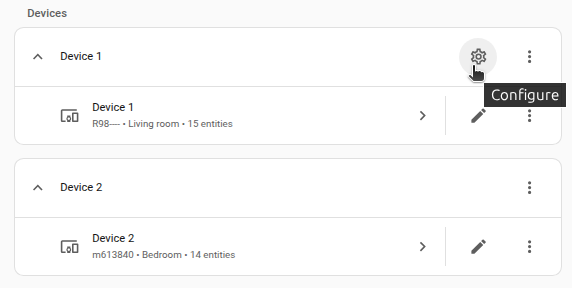
On the card, select the cogwheel
. - If the card does not have a cogwheel, the integration does not support options for this device.
-
Edit the options, then select Submit to save the changes.
Configuring partitions, zones, and outputs
After setting up the connection details, you can configure partitions, zones, and outputs as Subentries on the Satel Integra integration page.
A list of all partition, zone, and output IDs can be acquired by running the DLOADX program and connecting to your alarm. To create the respective entities, select the Add partition, Add zone, Add output, or Add switchable output buttons. Follow the instructions in the UI to set up the individual entities. Result: Each partition will have its own alarm panel. Each zone and output will have a binary sensor, and a switch will be created for each switchable output. Sensors will be created for each zone that has temperature sensor support enabled.
Having configured the zones and the outputs, you can use them for automation, such as to react on the movement in your bedroom. For example:
  alias: "Flick the input switch when movement in bedroom detected"
  triggers:
    - trigger: state
      entity_id: "binary_sensor.bedroom"
      to: "on"
  actions:
    - action: input_boolean.turn_on
      target:
        entity_id: input_boolean.movement_detected
Supported functionality
Binary sensors
- Service mode: Whether the panel is in service mode, activated during maintenance. Use it to pause automations while the panel is under maintenance.
- System trouble: Whether any system trouble is active on the alarm panel.
Individual trouble sensors
The individual trouble sensors are disabled by default. See Enabling and disabling entities to enable them.
- Panel AC trouble: Whether the panel has lost its AC power supply.
- Panel battery trouble: Whether there is a fault with the panel backup battery.
- Panel battery missing: Whether no backup battery is connected to the panel.
- Output {number} trouble: Whether there is a trouble condition on the specified output (outputs 1–4).
- Keypad power supply trouble: Whether there is a fault with the keypad power supply.
- Expander power supply trouble: Whether there is a fault with an expander module power supply.
- DT1 trouble: Whether there is a trouble on the first expander bus data line.
- DT2 trouble: Whether there is a trouble on the second expander bus data line.
- DTM trouble: Whether there is a trouble on the keypad bus data line.
- RTC trouble: Whether there is a real-time clock fault on the panel.
- EEPROM or RTC access trouble: Whether there is a fault accessing the panel’s EEPROM or RTC memory.
- RAM trouble: Whether there is a RAM memory fault on the panel.
- Panel restart memory trouble: Whether there is a fault with the panel’s restart memory.
- External device DTR trouble: Whether the panel detects no DTR (Data Terminal Ready) signal from an external device.
- External modem initialization trouble: Whether there is a failure during external modem initialization.
- External modem command trouble: Whether there is a command failure to the external modem.
- Telephone line bad signal trouble: Whether there is a poor signal quality on the telephone line.
- Telephone line no signal trouble: Whether there is no signal detected on the telephone line.
- Telephone line voltage or auxiliary processor trouble: Whether there is a telephone line voltage fault or an auxiliary processor fault, depending on the panel model.
- Monitoring station {number} trouble: Whether there is a trouble communicating with the specified monitoring station (stations 1–2).
Removing the integration
This integration follows standard integration removal. Once the integration is removed, consider disabling the communication ability to the ETHM-1 Plus module using DLOADX to reduce security risks.
To remove an integration instance from Home Assistant
- Go to Settings > Devices & services and select the integration card.
- Next to the entry you want to remove, select the three dots
menu. Then, select Delete. - Depending on the integration, the entries are listed under one of the following headings:
- Devices
- Hubs
- Services
- Integration entries
- Depending on the integration, the entries are listed under one of the following headings:
- To confirm, select Delete.
- Home Assistant also deletes the devices and entities of the entry.
- If Home Assistant asks you to restart, restart Home Assistant.
- If Home Assistant asks whether to also delete the application credentials, select Remove or Keep.
- If you keep them, Home Assistant uses them automatically when you add the integration again.
- To delete them later, refer to Deleting application credentials.